Bini – Ife Relationship Is One Of The Most Political Stunts in the History of West Africa
Published on: March 27, 2026
The claim that the monarchy of Benin originated from Ile-Ife through Oduduwa and his descendant Oranmiyan has become one of the most repeated narratives in modern West African history. It appears in textbooks, documentaries, and many modern historical writings. However, when early historical records are examined carefully, particularly the earliest European accounts from the 1400s and 1500s, the story becomes far less certain.
One of the most important early sources describing the Kingdom of Benin is Esmeraldo de Situ Orbis, written between 1506 and 1510 by the Portuguese explorer Duarte Pacheco Pereira. This document is extremely valuable because it was written only a few decades after the Portuguese first established contact with Benin in the late fifteenth century.
What is striking in these early Portuguese descriptions is what they include and what they do not include. They describe the Benin kingdom in considerable detail, including its political structure, urban planning, trade systems, and regional connections. Yet nowhere in these early records do we find any mention of Ile-Ife, Oduduwa, or Oranmiyan as founders or sources of Benin’s monarchy.
Instead, the early sources describe Benin’s connections to eastern regions such as Igala, Nupe, and Isan, including a powerful priest-king located east of Benin who the Portuguese called the Ogané. This figure is widely believed today to correspond to the Eze Nri of the Nri civilization.
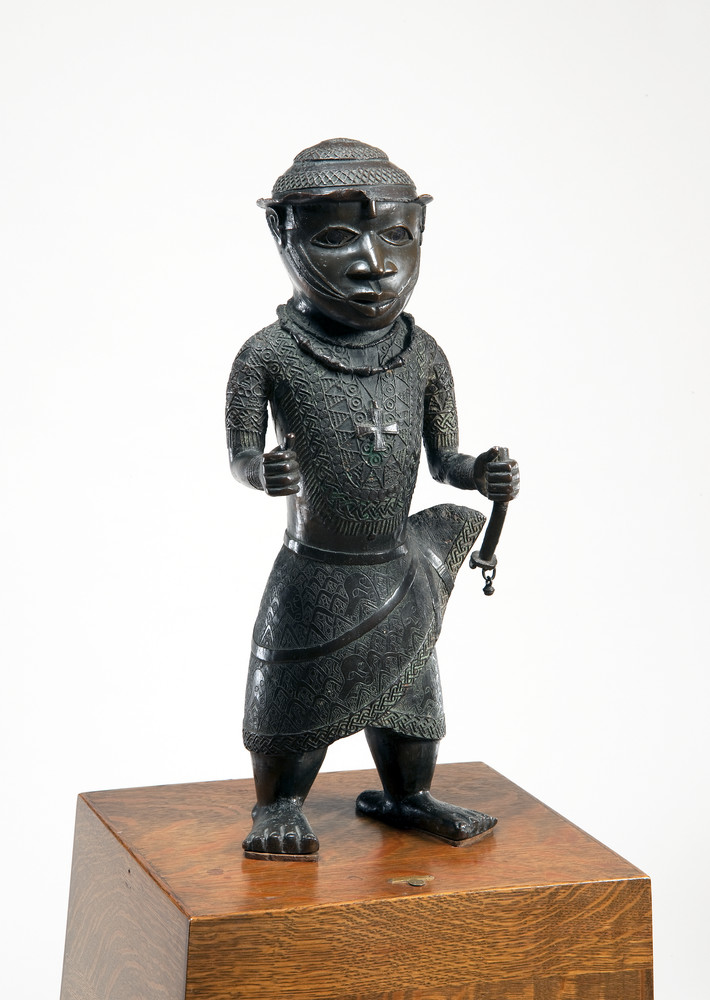
The Portuguese Description of the Priest-King East of Benin
In Esmeraldo de Situ Orbis, Duarte Pacheco Pereira recorded the existence of a powerful spiritual ruler located east of Benin who commanded immense respect from the Oba and surrounding peoples. The Portuguese recorded this figure as the “Ogané.”
The text describes the relationship in the following words:
“The King of Benin holds the priest called Ogané in very great reverence, for he is regarded as a holy man and spiritual lord by the peoples of those lands.”
This description suggests that the Oba of Benin recognized the spiritual authority of this eastern priest-king. Many modern historians identify this Ogané with the Eze Nri, the ritual leader of the Nri civilization in present-day southeastern Nigeria.
This connection is significant because it indicates that early external observers saw Benin’s strongest cultural or religious relationship pointing eastward rather than westward toward Ile-Ife.
The Silence About Ile-Ife in Early Records
Portuguese traders, explorers, and missionaries documented Benin extensively during the 15th and 16th centuries. They described the famous wide streets of the capital, the political authority of the Oba, the organization of guilds, and the elaborate royal court ceremonies.
Despite this detailed documentation, references to Ile-Ife as the origin of Benin’s monarchy do not appear in these early sources. Neither Oduduwa nor Oranmiyan are mentioned in the earliest written accounts.
This absence is extremely important. Foundational origin stories usually form the core of a kingdom’s identity and legitimacy, meaning they are often among the first things outsiders record. The fact that the earliest sources are silent about the Ife connection suggests that the narrative may have developed later.
Evidence of Eastern Cultural Influence
Early historical evidence instead suggests strong interactions between Benin and regions east and north of it, particularly Igala, Nupe, and other societies of the Niger–Benue cultural corridor.
Trade networks along the Niger and Benue rivers linked these regions for centuries. Cultural ideas, religious traditions, and political influences traveled along these routes long before the arrival of Europeans.
The Portuguese reference to the Ogané priest-king fits perfectly into this regional context. The Nri civilization was widely respected for its ritual authority and spiritual influence across large parts of southeastern Nigeria.
Thus, when early Portuguese writers described the Oba of Benin respecting a priest-king to the east, they were likely recording a real regional spiritual hierarchy that existed long before colonial interpretations reshaped historical narratives.
Migration and the Yoruba Historical Question
Archaeological and linguistic evidence indicates that Yoruba-speaking peoples may have emerged from the broader Niger–Benue cultural zone, including areas associated with Nupe, Igala, and Borgu. Over time, these groups moved southwest into their present territories.
This pattern of migration would explain the linguistic similarities and shared cultural features between these regions today. However, modern interpretations sometimes reverse this direction, presenting Yoruba lands as the original source from which surrounding groups emerged.
Population movements across West Africa were often shaped by warfare, slave raids, and political upheaval rather than by a single ancient settlement center.
Wars, Raids, and Population Displacement
Throughout the eighteenth and nineteenth centuries, powerful states such as Oyo, Dahomey, and Nupe engaged in repeated conflicts across the region. Nupe forces ransacked Oyo multiple times, and Dahomey also fought major wars with neighboring states.
These wars created large numbers of captives who were sold into the Atlantic slave trade through coastal ports including Benin and Elmina. Many enslaved individuals identified in the Americas as “Lukumi” were Yoruba speakers.
This historical reality suggests that many Yoruba communities experienced warfare and enslavement during these periods rather than occupying a permanently dominant political position.
The Role of 19th Century Returnees
During the nineteenth century, thousands of formerly enslaved Africans returned from Brazil, Cuba, and Sierra Leone to West Africa. In Yoruba areas they became known as the Aguda.
These returnees brought Christianity, literacy, new political ideas, and connections with European missionaries and colonial authorities. Many became influential within emerging colonial administrations.
Some historians argue that during this period Yoruba history was reorganized and standardized, with Oduduwa and Ile-Ife elevated as a central origin story meant to unify various Yoruba communities.
The British Destruction of Benin in 1897
Another major factor often ignored in historical discussions is the catastrophic disruption caused by the British invasion of Benin in 1897. British forces burned the royal palace, killed many palace officials, looted thousands of artworks, and exiled the Oba to Calabar.
This event destroyed the institutional system that had preserved Benin’s historical traditions for centuries. The palace guilds responsible for maintaining oral records and royal archives were killed, scattered, or forced into hiding.
Shrines, archives, and sacred objects that carried historical memory were burned or taken to Europe. After this event, the traditional system responsible for preserving Benin history no longer existed in its original form.
Who Preserved the History After 1897?
This raises an important question: if the custodians of Benin history were killed or displaced in 1897, who preserved the original traditions afterward?
In many cases, Benin history had to be reconstructed by colonial officers, interpreters, Christian converts, and later writers such as Jacob Egharevba during the twentieth century. While these efforts helped document important traditions, they were conducted within a colonial environment where earlier historical systems had already been disrupted.
This helps explain why some narratives, including the Ife–Benin origin claim, appear more prominently in twentieth-century writings than in the earliest European records.
Conclusion
The relationship between Benin and Ile-Ife remains one of the most debated subjects in West African history. However, early documentary evidence, particularly Portuguese records such as Esmeraldo de Situ Orbis, does not support the claim that Benin’s monarchy originated from Ife.
Instead, the earliest sources describe strong connections between Benin and eastern regions such as Igala, Nupe, and the priest-king Ogané, widely associated with the Eze Nri.
When combined with the disruptions caused by warfare, the Atlantic slave trade, nineteenth-century returnee communities, and the destruction of Benin’s traditional historical institutions in 1897, it becomes clear that historical narratives in the region have evolved through complex political and social processes.
Disclaimer
This article discusses historical interpretations based on available linguistic, documentary, and archaeological evidence. Historical debates about origins and cultural relationships remain complex and continue to evolve as new research emerges. The purpose of this article is to encourage critical examination of historical sources rather than to diminish any culture or community.